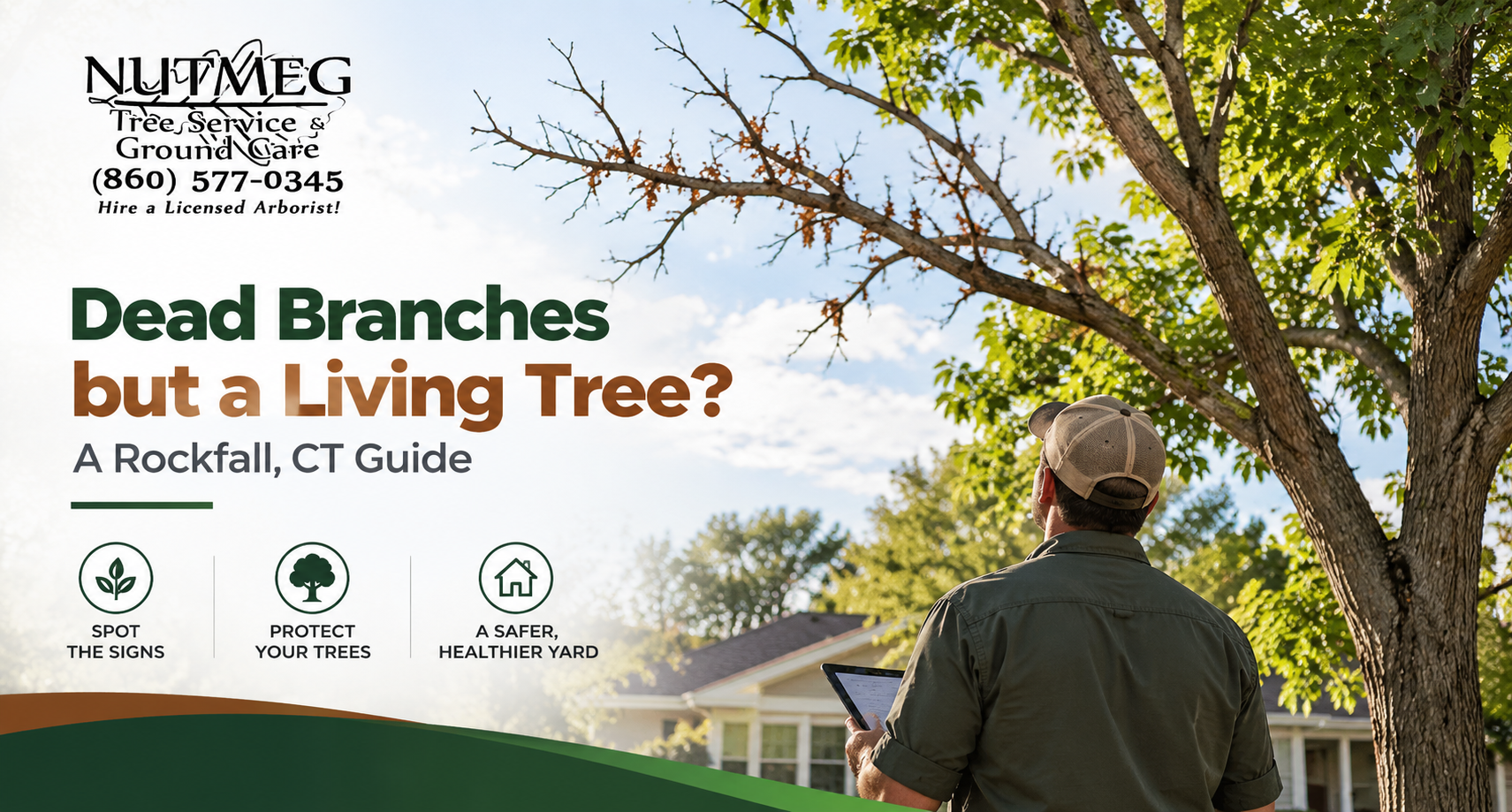
Seeing dead branches on a tree can be worrying, especially when the rest of the tree still looks green and healthy. Does it mean the entire tree is dying? Should the dead branches be removed immediately? Or is some branch loss normal?
The answer depends on what is causing the branches to die and how much of the tree is affected. A few dead limbs do not automatically mean a tree needs to be removed. However, dead branches can sometimes point to stress, disease, structural problems, or environmental conditions that deserve attention. Understanding the difference can help Rockfall, CT homeowners make better decisions about their trees.
A Dead Branch Does Not Always Mean a Dead Tree
Trees are living systems, and individual branches can die while the rest of the tree continues to grow. A branch may lose access to enough sunlight, become damaged during a storm, suffer from disease, or simply decline because of natural competition within the canopy.
The important thing is to look at the overall condition of the tree. Healthy leaves, new growth, a stable trunk, and a generally full canopy can be positive signs even when a few branches have died.
Professionals such as Nutmeg Tree Service and Ground Care evaluate tree conditions and provide services including pruning, removal, cabling and bracing, and insect and disease troubleshooting.
Why Do Individual Branches Die?
There is no single reason. Sometimes branches are damaged by wind, snow, or ice. Connecticut’s changing seasons can put significant stress on trees, particularly when heavy weather affects already weakened limbs.
Other causes may include insects, disease, poor growing conditions, root problems, drought stress, or competition for sunlight. Branches deep inside a dense canopy may also receive less light and gradually decline.
Because several different problems can produce similar visible symptoms, homeowners should avoid assuming that one dead branch tells the whole story.
What Can You Safely Look for From the Ground?
You do not need to climb a tree to notice useful warning signs. In fact, homeowners should avoid climbing or attempting to cut large or elevated branches themselves.
From a safe distance, look at the distribution of dead branches. Is there only one isolated limb, or are branches dying throughout the canopy? Are leaves missing from one section? Is bark falling away? Are there visible cracks where a large limb connects to the trunk?
Also pay attention to changes over time. One damaged branch after a storm is different from a tree that continues losing branches season after season.
Dead Branches Can Become a Safety Concern
Once a branch dies, its wood can gradually weaken. Eventually, it may break during wind, heavy rain, snow, or even calm weather.
Location therefore matters. A small dead branch over an unused part of the yard presents a different situation from a large dead limb hanging above a driveway, roof, sidewalk, play area, or frequently used outdoor space.
Homeowners looking into tree care and maintenance services near Rockfall CT should consider both the health of the tree and what could be affected if a weakened branch falls.
Can Pruning Help a Tree With Dead Branches?
In many cases, proper pruning can remove dead, damaged, or problematic branches while preserving the healthy parts of the tree.
Pruning is not simply about making a tree look neat. Nutmeg Tree Service explains that pruning should have a specific purpose, and mature-tree pruning can be used to help maintain tree health. Removing selected dead wood can also reduce the number of weakened branches remaining in the canopy.
However, unnecessary or excessive pruning can create additional stress. The amount, location, and size of the branches involved should influence how the work is approached.
When Might the Problem Be More Serious?
Dead branches deserve closer attention when they appear alongside other changes.
For example, a tree may need further evaluation if a significant portion of its canopy is declining, the trunk has major cracks or cavities, mushrooms or fungal growth appear around certain areas, the tree has developed a new lean, or branches are dying rapidly.
These symptoms do not automatically mean removal is necessary. They simply provide more information about the tree’s condition. Some trees may benefit from pruning, structural support, or management of an insect or disease issue. Others may have damage that cannot reasonably be corrected.
Why Tree Structure Matters Too
A tree can look green and still have structural weaknesses.
Large branches may grow with poor attachments, trunks can develop weak unions, and previous storm damage can leave vulnerable areas. Nutmeg Tree Service also provides cabling and bracing for certain structural situations, showing why evaluating the physical structure of a tree can be just as important as looking at leaf color.
This is particularly important for mature trees located close to homes, roads, vehicles, or areas where people regularly spend time.
Do Not Wait for a Branch to Fall
One of the easiest times to notice tree problems is after leaves appear in spring and summer because dead sections can stand out against the living canopy. Homeowners can also look for changes after strong storms or during seasonal yard maintenance.
The goal is not to remove every imperfect tree. Mature trees provide shade, character, privacy, and environmental value. The better approach is to understand what is happening before deciding what action makes sense.
Final Thoughts
A tree with dead branches is not necessarily a dead tree. Individual limbs can decline for many reasons while the rest of the tree remains healthy.
For Rockfall homeowners, the key is to look at the bigger picture: how many branches are affected, where they are located, whether the problem is spreading, and whether there are other signs of stress or structural weakness.
Early attention can make it easier to distinguish routine pruning needs from a more significant tree-health or safety concern—and help homeowners make informed decisions while preserving healthy trees whenever practical.