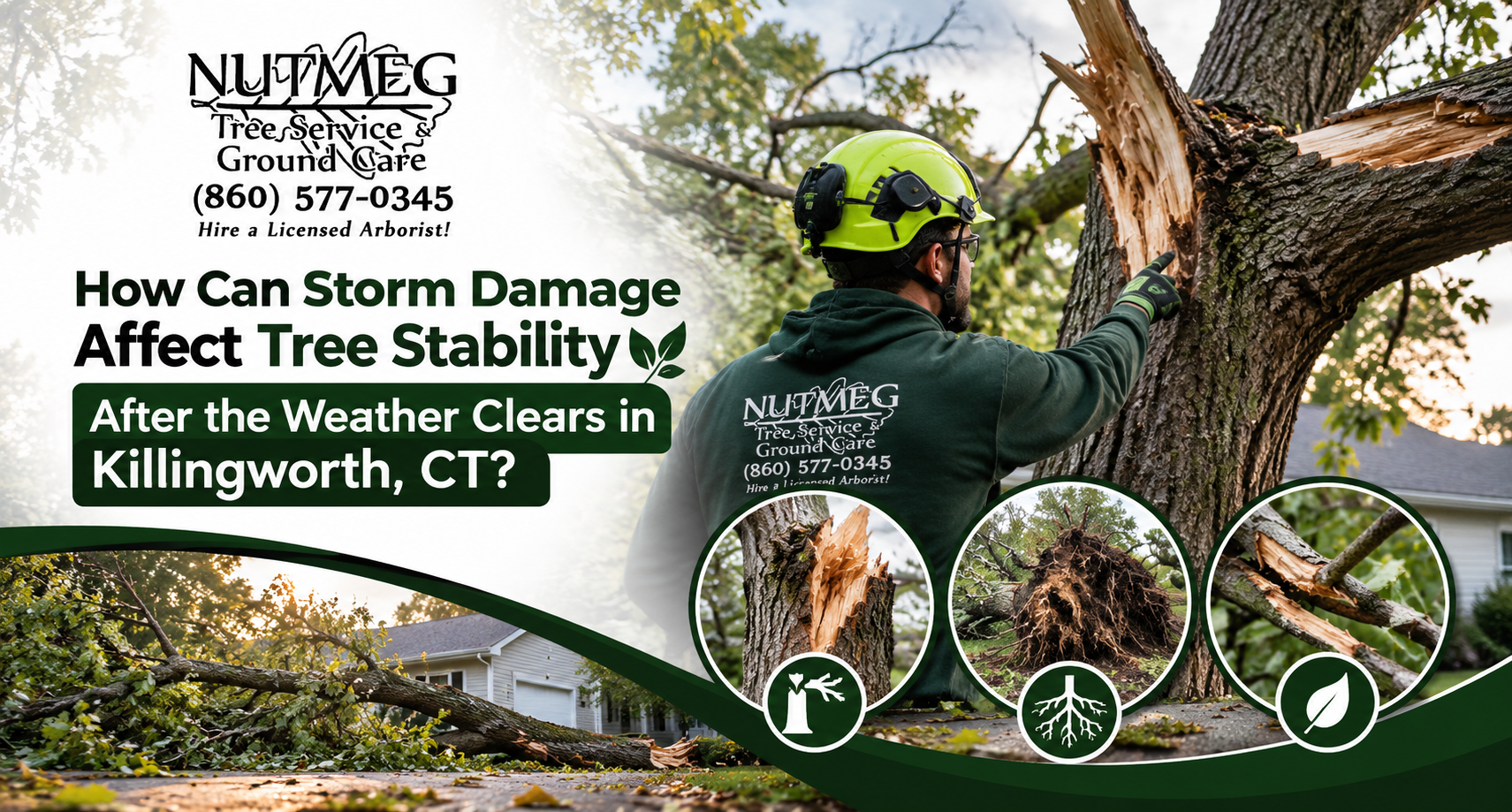
A storm can leave more than fallen branches and scattered debris behind. Strong winds, heavy rain, lightning, and saturated soil can affect a tree’s stability even when the weather has already cleared. A tree may still look standing and healthy while having hidden damage to its branches, trunk, or root system.
For homeowners in Killingworth, CT, checking trees after severe weather is an important part of protecting the property. Understanding what to look for can help identify potential hazards before damaged trees or branches create a larger problem.
Why Can a Tree Become Unstable After a Storm?
Trees are designed to withstand normal weather conditions, but severe storms can place significant stress on their structure. Strong winds can push branches in different directions, while heavy rain can saturate the soil around the roots.
A tree may survive the storm but have weakened areas that are not immediately obvious. Cracks, broken branches, loose roots, or changes in the tree’s position may only become noticeable after the weather has passed.
This is why storm damage should not be judged only by looking for trees that have completely fallen.
Check for Broken or Hanging Branches
One of the easiest signs of storm damage is broken branches. Large branches can split or partially break while remaining attached to the tree.
These branches may become unstable and fall later, particularly during another period of strong wind. Smaller broken branches can also create entry points for insects or disease.
Homeowners should avoid standing directly beneath damaged branches or attempting to remove large limbs themselves. A professional assessment can help determine whether damaged branches can be safely removed or whether additional tree work is necessary.
Look for Cracks in the Trunk or Major Branches
Storms can cause cracks in a tree’s trunk or at the points where major branches connect to the main stem.
Not every crack means that a tree needs to be removed, but significant cracks can indicate structural weakness. Cracks around major branch unions can be especially important because these areas carry substantial weight.
If you notice a new crack after a storm, it is better to have the tree evaluated rather than assuming it will heal on its own.
Pay Attention to Leaning Trees
A tree that suddenly appears to be leaning differently after a storm deserves attention.
Strong winds can move a tree, while saturated soil can reduce the support provided by the root system. In some situations, a tree may remain standing but have become less stable.
Look for changes in the soil around the base, raised roots, exposed roots, or a noticeable change in the tree’s position. These signs can indicate that the storm affected the tree’s stability.
Inspect the Area Around the Roots
Roots provide much of a tree’s support. Heavy rainfall can saturate soil and make it easier for a tree to shift, particularly when combined with strong winds.
After a major storm, homeowners should look for disturbed soil, exposed roots, cracks in the ground, or soil that appears to have lifted around the base of the tree.
Root damage can be difficult to assess from the surface, so visible changes around the base should not be ignored.
A Tree Can Look Healthy and Still Have Damage
One of the biggest challenges with storm damage is that not every problem is easy to see.
A tree may still have green leaves and an intact trunk while having a damaged branch attachment or weakened root system. Some structural problems may only become obvious when another storm places additional stress on the tree.
This is one reason post-storm tree inspections can be useful, especially for large trees located close to homes, garages, driveways, sidewalks, or other frequently used areas.
Why Location Matters
The potential consequences of storm damage depend partly on where a tree is located.
A damaged tree in an open area may pose less immediate risk than one standing next to a house or over a driveway. Branches extending above a roof, power lines, vehicles, or areas where people regularly walk deserve particular attention.
Homeowners should consider not only the condition of the tree but also what could be affected if a damaged branch or tree were to fall.
What Should You Do With Storm-Damaged Trees?
The first step is to keep people and pets away from obviously damaged or unstable areas. Do not climb a damaged tree or attempt to cut large branches with household equipment.
If a tree is leaning, has major broken limbs, has visible trunk damage, or appears to have shifted at the roots, professional evaluation can help determine the appropriate next step.
Nutmeg Tree Service and Ground Care provides tree care services throughout Middlesex County, including storm cleanup, tree removal, pruning, cabling and bracing, and other tree-care services.
When Can Pruning Help?
Not every storm-damaged tree needs to be removed. In some situations, properly performed pruning can address damaged branches while allowing the remaining tree to continue growing.
The appropriate approach depends on the extent and location of the damage. Removing only the necessary damaged material can be preferable to making unnecessary cuts to otherwise healthy parts of the tree.
Homeowners should avoid attempting major storm-damage pruning themselves, especially when branches are large, elevated, or close to structures.
When Might Removal Be Necessary?
A severely damaged tree may sometimes require removal if its structural condition creates an unacceptable hazard or if the tree has sustained extensive damage.
However, removal should not automatically be the first choice after every storm. A qualified tree professional can assess the tree’s condition and determine whether pruning, cabling, bracing, monitoring, or removal is appropriate.
Nutmeg Tree Service also provides storm cleanup and hazardous tree services for properties in the area.
Storm Damage Can Create Problems Later
The effects of a storm do not always end when the rain and wind stop. A weakened branch can fall later, and a tree with disturbed roots may become increasingly unstable as conditions change.
That is why homeowners should take a few minutes to inspect their property after significant weather. If you notice changes that are difficult to evaluate, professional guidance can help you understand the condition of the tree.
For homeowners researching tree care and maintenance services near Rockfall CT, understanding these warning signs is a useful first step toward maintaining healthy and stable trees.
What Killingworth Homeowners Should Remember
After a major storm, look beyond obvious fallen branches. Check for broken limbs, trunk cracks, leaning trees, disturbed soil, exposed roots, and changes around major branch connections.
If a tree is close to a home or another structure, even seemingly minor storm damage deserves careful attention. Professional tree services can evaluate difficult-to-see structural problems and determine whether cleanup, pruning, support, or removal is appropriate.
For local homeowners, tree service in Killingworth, CT is available for evaluating and addressing a range of tree and ground-care needs.
Storm cleanup is not only about making the yard look tidy again. It is also about identifying changes that could affect tree stability in the days and weeks after severe weather. Taking those warning signs seriously can help Killingworth homeowners protect their property while giving healthy trees the attention they need.